Umbraught
Chasing SunlightThe Umbraught are an ancient species whose existence is defined by an inverse relationship to human light. They consume luminiferous terrestrite and carry a painful purple-grey radiance that is incompatible with the zint illumination sustaining human civilization. Their sudden return at Angkor Leng transforms the Endeavor’s attempt to repair and refuel into a crisis: the expedition is forced to defend itself against beings that the Inquisition considers an existential danger to the settled world.
Identity and Nature
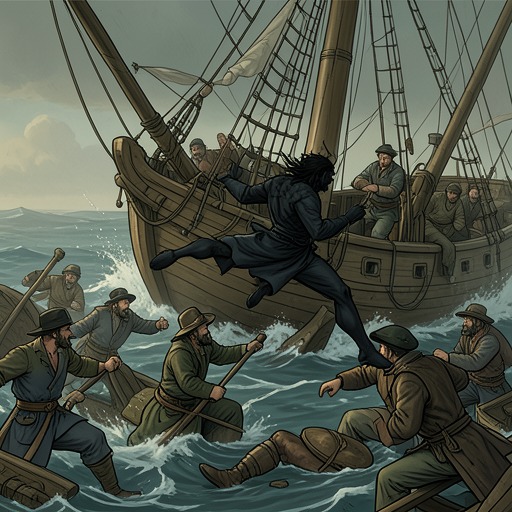
The Umbraught are described as dark, nearly human-shaped figures whose bodies are difficult to perceive except through reversed colors marking their eyes, teeth, and clothing. Their forms are not simply blackened versions of human bodies; the creatures appear distorted, partly ephemeral, and physically opposed to ordinary human existence. The light they prefer is itself their most conspicuous attribute. It is dark purple-grey rather than bright, yet its indirect reflections sting the eyes like the glare of lightning, and it can overwhelm or suppress the zint lanterns and shadows around it.
Their relationship to light is therefore biological, material, and political at once. Human society extracts and distills luminiferous terrestrite, transports it through industrial infrastructure, and uses its energy to illuminate cities, propel airships, and operate weapons. The Umbraught consume that same resource, but their presence produces an antithetical radiance rather than the blue-white order associated with human civilization. In this sense, they are not merely monsters inhabiting darkness: they embody a competing energy regime within a world whose political legitimacy is organized around control of illumination.
The wider setting has already established that the darkness is populated by races and forces that human civilization tries to contain. At Danby’s Point, human construction meets alien architecture and nonhuman populations at the eastern edge of the illuminated world, while the Inquisition is simultaneously strongest and weakest because trade makes contact unavoidable. The Umbraught belong to this broader frontier of alterity, but their connection to luminiferous terrestrite gives them a more direct and dangerous relation to the infrastructure of human power than the strange inhabitants encountered in ordinary commerce.
Return at Angkor Leng
The Umbraught re-enter the expedition’s immediate story at Angkor Leng. Jonathan and his companions have just emerged from a damaged section of the city carrying a large quantity of gold when the blue light of the Endeavor’s spotlights becomes visible in the distance. From the opposite direction comes another illumination: dim, dark purple-grey, and painful to the eye. Antomine recognizes the sign before the others can identify it and explains that the Umbraught consume luminiferous terrestrite.
According to Antomine, the Illuminated King destroyed or drove the Umbraught out hundreds of years earlier. Their appearance in Angkor Leng therefore marks both a historical recurrence and a failure of containment. The Endeavor’s unusually powerful spotlights may have attracted them, since the ship carries far more effective illumination than Jonathan’s earlier visit to the city had possessed. Jonathan, however, suspects that Antomine’s presence may be the more likely explanation, suggesting that the Inquisition’s history and activities are themselves capable of drawing old threats back into the world.
The expedition does not initially know whether the Umbraught are approaching or merely moving through the city. Buildings interrupt the sight lines, Angkor Leng’s machinery drowns out the strange light, and only reflections stabbing across metal and stone reveal that something may be closing in. By the time the group reaches the hangar, the uncertainty has become a psychological weapon. Men rub their sore eyes, grow twitchy, and imagine that an enemy from the time of the Kingdom’s founding is stalking them through the ruins.
Assault on the Endeavor
The attack begins when the hangar’s massive brass control-room door slides open. A crowd of dark figures rushes through the opening, nearly invisible except for the reversed colors of their bodies. Each carries a baffling sphere that emits the Umbraught’s characteristic radiance. The light appears faint, but it drowns out the zint lanterns and helps conceal the attackers’ rapid movements.
The Lux Guard at the entrance is immediately thrown backward, a reversal that shocks the airmen because the guards have established a reputation for efficiency during the journey. Jonathan responds by taking up a heavy gold club made from a branch he and Eleanor have removed from the ruined structure. When an Umbraught raises a black-edged blade to intercept his blow, the blade snaps under the force of the impact, and the creature folds around the strike and is hurled into its companions.
Jonathan’s attack breaks the hesitation among the airmen. Eleanor and her maids engage with daggers, while Antomine and his guards are weakened by the presence of the dark creatures and their inverted light. The fight is brief despite the Umbraught being nearly as numerous as the airmen, because Jonathan, Eleanor, and the maids are far more effective in close combat than the attackers. Jonathan uses the unwieldy gold club with deliberate brutality, while Eleanor turns her own anger against the creatures.
Antomine identifies the decisive vulnerability: the Umbraught’s lanterns must be destroyed. Jonathan crushes one of the luminous spheres beneath his boot, after which the airmen smash others with clubs and swords. Eleanor and the maids pursue those attempting to flee, although Jonathan recognizes that the attackers may have sent runners before entering the hangar and therefore assumes that not all of them have been caught.
Once the spheres are broken, the stinging in Jonathan’s eyes fades. The Umbraught bodies themselves begin to disappear, becoming increasingly unreal now that their peculiar light has been extinguished. Their fading suggests that the creatures are not simply using the radiance as equipment; their very existence is bound to it. The zint light that supports human society and the dark light that sustains the Umbraught are presented as mutually incompatible conditions of being.
Conflict with the Inquisition
The assault intensifies the disagreement between Antomine and Jonathan over the expedition’s obligations. Antomine insists that if a nest of Umbraught exists in Angkor Leng, it must be purged immediately. Once the creatures know that zint exists, he argues, they will hunt it down, and a westward movement could cause damage across human civilization. His concern extends beyond the safety of the Endeavor: he treats the protection of future settlements as part of the present expedition’s duty.
Jonathan rejects that responsibility. He reminds Antomine that they are not a navy and lack the time and resources to survey and cleanse a city as large as Angkor Leng. The city is already a damaged and difficult environment, and the Endeavor still needs treatment before it can continue toward the true east. Jonathan regards the proposed campaign as another diversion from his pursuit of sunlight, while Antomine sees refusal as a willingness to abandon civilization for convenience.
This dispute exposes two competing meanings of exploration. For Jonathan, the expedition is organized around a singular personal objective, and every stop, supply decision, and armed encounter is judged by whether it advances the route eastward. For Antomine, travel through the darkness carries a broader institutional obligation: threats discovered along the way must be contained before they reach the illuminated lands. The Umbraught thus become more than an attacking species. They are the point at which Jonathan’s private quest collides with the Inquisition’s doctrine of frontier management.
The argument also recalls the expedition’s wider pattern of contested materials. At Danby’s Point, Jonathan has loaded the Endeavor with a portable luminiferous terrestrite distillation apparatus, a lifting-gas separator, water systems, searchlights, crew-served zint guns, and extensive stores. Some cases have already been opened, especially those containing fire dust and unflame, while later repairs reveal that tools and replacement supplies have been stolen. The Umbraught attack makes the vulnerability of this energy-dependent expedition literal: the ship’s lights are both its protection and the signal that summons an enemy.
Consequences and Significance
The immediate casualties of the assault are serious but not fatal. Airmen suffer bleeding cuts, sprains, bruises, and broken limbs, while at least one Lux Guard is knocked down so violently that Antomine must help move him aside. The encounter leaves the crew injured and shaken, but the Endeavor remains the central object of concern. It is being hauled into the hangar by winches and tether lines, and the crew cannot risk compressing the envelope for a conventional landing while an enemy may still be nearby.
The Umbraught’s reappearance also changes the meaning of Angkor Leng. The city is not merely a repository of ancient machinery or a possible gateway to the east. It is a place where old historical violence has not ended, where the Illuminated King’s claimed victory over an enemy may have been incomplete, and where the arrival of modern human technology can awaken dormant opposition. The expedition’s powerful spotlights make the ship more capable, but they also extend the reach of the forces that can detect it.
Their visual and material opposition to zint gives the Umbraught a distinctive narrative function. The human world calls itself a vigil of light against eternal darkness, and its industrial quarter is built around the extraction and distillation of the energy that makes that vigil possible. Yet the Umbraught reveal that darkness is not empty absence. It contains its own organisms, technologies, and forms of power. The human claim that civilization belongs naturally to the light is therefore challenged by a species that inhabits an alternative illumination and treats human energy as a consumable resource.
The species remains only partly understood. Antomine knows their historical reputation and their appetite for luminiferous terrestrite, but he does not explain what the Umbraught are capable of beyond their attack, their use of painful lanterns, and their apparent dependence on inverted radiance. That withheld knowledge preserves their threat. They are seen closely enough to be fought, yet not understood closely enough to be reduced to a familiar enemy. Their brief appearance leaves behind an unresolved question of scale: the assault may have been a local nest defending its territory, or the first sign that the old conflict between the two light systems is beginning again.